
Quality Assurance in Chinese Glass Manufacturing

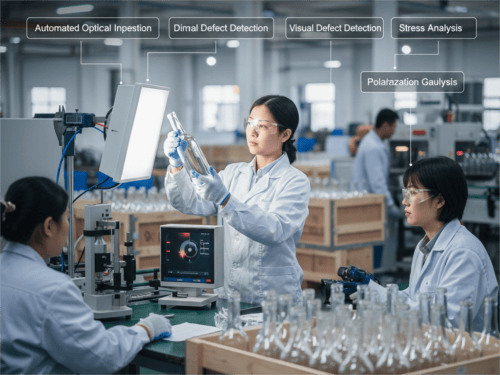
Chinese Glass Manufacturing – For global brands sourcing glass packaging, quality and consistency are paramount. Leading Chinese manufacturers ensure these standards through a sophisticated blend of high-grade raw materials, precision engineering, and rigorous multi-stage testing.
1. Superior Raw Material Control
The integrity of a glass bottle begins in the furnace. Manufacturers source high-purity silica sand, soda ash, and limestone from reputable suppliers, screening for trace elements that could affect clarity or strength. A critical component is cullet (recycled glass), which not only improves environmental sustainability but also ensures the molten glass reaches the correct viscosity at temperatures near $1600^\circ\text{C}$.
2. Precision Melting and Forming
Modern Chinese facilities utilise automated proportioning systems to ensure chemical stability. Once the materials are melted, robotic arms feed the molten glass into precision-engineered moulds. This automated process minimises human error, ensuring that every bottle—whether intended for a delicate perfume or a high-pressure carbonated beverage—maintains a uniform shape and weight.
3. The Annealing Process: Removing Internal Stress
A hallmark of high-quality glass is its durability. After forming, bottles undergo annealing in a controlled kiln known as a ‘lehr’. By slowly reheating and gradually cooling the glass, manufacturers relieve internal thermal stresses. Without this step, glass becomes brittle and prone to spontaneous shattering. Success is verified using polarised light observation; a specific colour spectrum (typically reds and purples) confirms that the stress has been successfully relieved.

4. Comprehensive Inspection Regimes
To eliminate defects, manufacturers employ a “multi-gate” inspection strategy:
- Automated Optical Inspection (AOI): High-speed cameras and sensors scan for “stones,” bubbles, or cracks that are invisible to the naked eye.
- Dimensional & Wall Thickness Checks: Sensors ensure the glass distribution is consistent, particularly at the base and neck, to prevent weak spots.
- Pressure and Impact Testing: Bottles are subjected to internal hydrostatic pressure tests and pendulum impact tests to simulate the rigours of transport and carbonation.
- Thermal Shock Resistance: Samples are moved rapidly between extreme temperatures to ensure they can withstand pasteurisation or rapid filling processes.
5. Automation and the Future
The industry is rapidly shifting towards Industry 4.0. By integrating the Internet of Things (IoT) and AI, factories can monitor furnace temperatures and mould performance in real-time. This data-driven approach allows for “predictive quality,” where potential defects are identified and corrected before the production run is even completed.
| Quality Pillar | Method of Control | Benefit to Client |
| Purity | Chemical analysis of silica/soda ash | Crystal-clear, blemish-free glass |
| Strength | Controlled annealing & stress testing | Reduced breakage during transit |
| Uniformity | Automated “Press-and-Blow” moulding | Reliable sealing and aesthetic consistency |
| Integrity | Pressure & thermal shock testing | Safe for carbonated or hot-fill liquids |
Conclusion
By combining traditional craftsmanship with cutting-edge automation, Chinese glass manufacturers provide high-performance packaging that meets strict international standards. This rigorous oversight ensures that every bottle is as durable as it is visually striking.